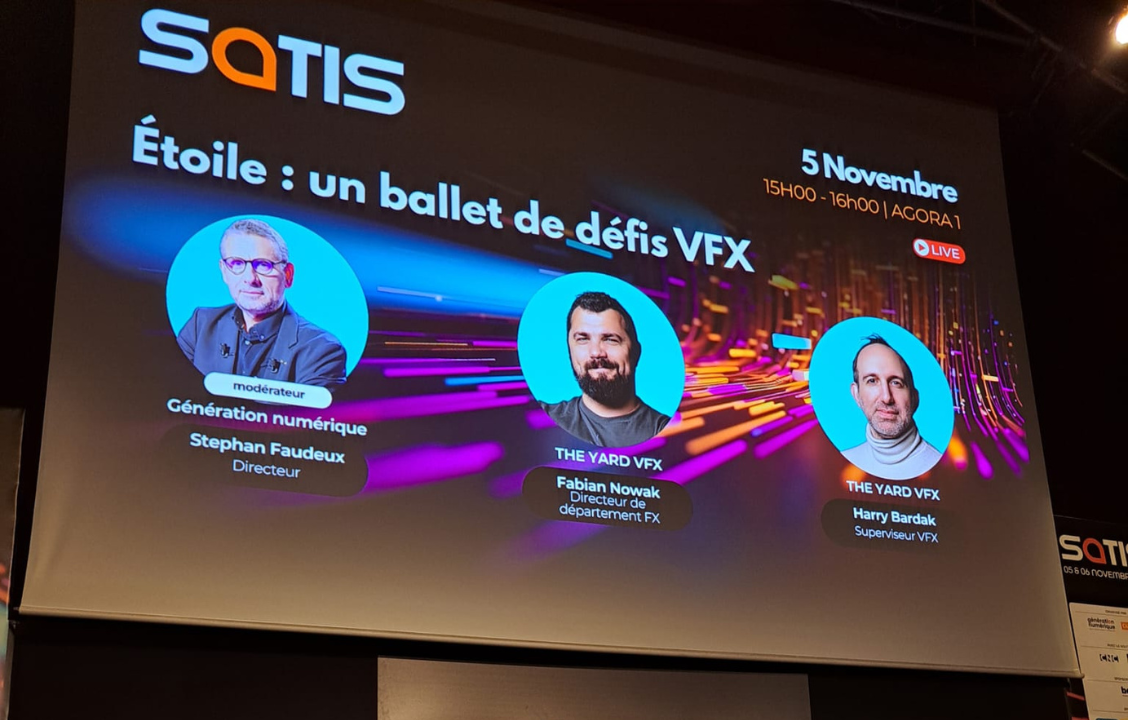
Take a deep dive into the VFX work of The Yard on Etoile, a Prime Video series, with the recording of our presentation at SATIS 2025.
At this year’s SATIS Expo, a French trade show that serves as a major industry crossroads, showcasing diverse tech innovations for media and audiovisual markets through exhibitions, demos, conferences, and networking, The Yard had the pleasure to be invited to present its work on the Prime Video series, Etoile.
Now, you can step behind the scenes and watch VFX Supervisor, Harry Bardak, and Head of FX, Fabian Nowak, sharing insights on the making of the series’ storm sequenece. The recording is available free of charge by clicking here (in French only)
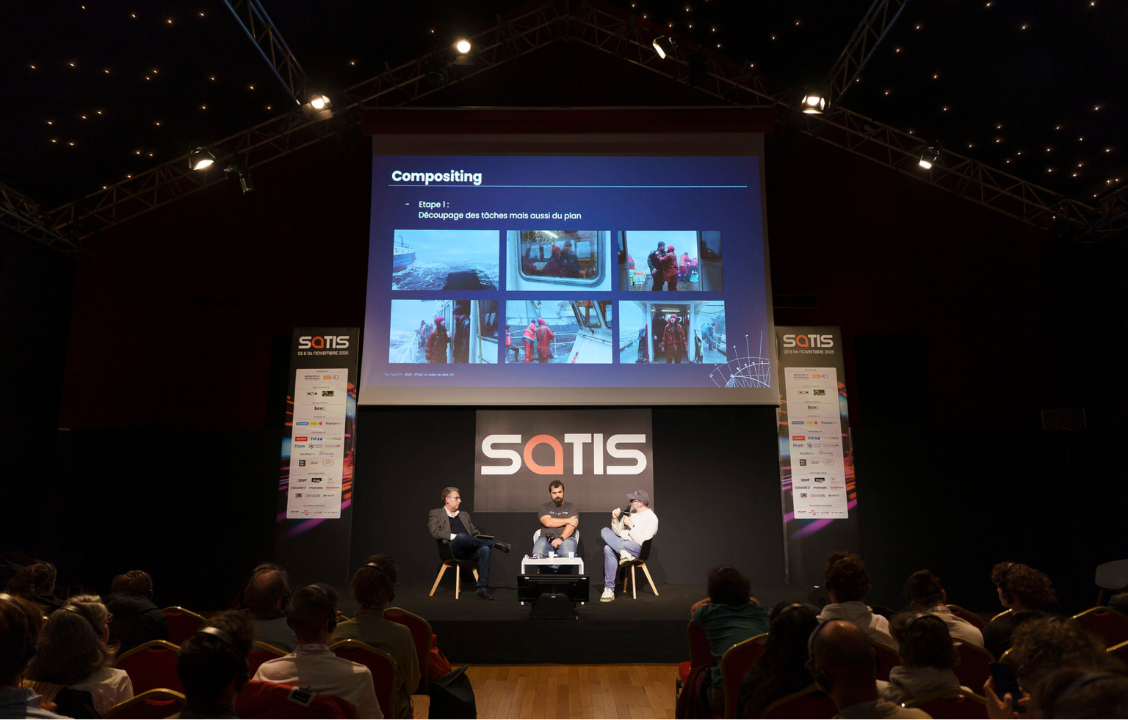
After an overview of the work that The Yard tackled on the series, Harry Bardak and Fabian Nowak focusd on the most ambitious sequences of Étoile: a storm-at-sea scene built around a 3,000-frame, shot with a steadycam in a water tank in Belgium.
As Harry Bardak explained, the show’s VFX had to remain invisible and entirely at the service of the storytelling, which proved particularly challenging given the mix of partial sets, continuous camera movement, and the need to sync every practical effects with complex digital simulations.
To recreate a raging ocean around the physical set, The Yard developed custom systems to simulate water, waves, rain, fog, spray, and atmospheric volumetrics, rigorously aligning them with real splashes and the oscillations of the moving platform. The team crafted procedural oceans, fluid simulations, foam systems, and even designed specific wave behaviours between two boats, while also animating clothing, ropes, flags, and a fully digital fishnet filled with fish. They added 3D extras and rebuilt thin props too difficult to roto, extended the environment to a true horizon, and created a 25-meter trawler integrated into the storm.
Split into six sections and involving up to 50 compositing layers per shot, the sequence required tight coordination, extensive visual development, and months of FX and compositing work—ultimately delivering an immersive, visceral shot where the line between real footage and visual effects becomes imperceptible.