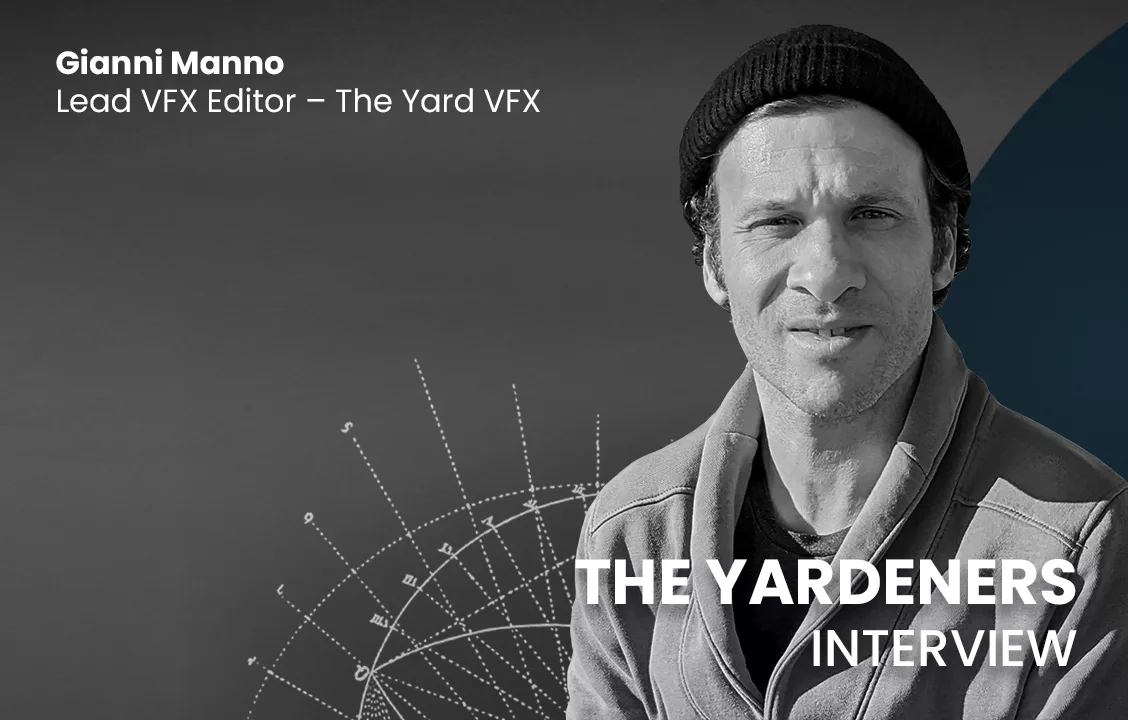
The Yardeners – Gianni Manno, Lead VFX Editor

  • 2026-04-16
Meet the Yardeners – the passionate team at The Yard, who cultivate every day the seeds of creativity, transforming them into striking visual effects, fruitful collaborations, and unforgettable stories.
This week, we’re excited to introduce Gianni Manno, our talented Lead VFX Editor. With nearly two decades in the entertainment industry, Gianni’s journey is anything but conventional—from motion design and compositing in French post-production studios, across both film and advertising, to the precise and pivotal role he’s held for the past three years at The Yard.

Hello Gianni ! Could you please explain your current role at The Yard ? 

At The Yard VFX, the VFX Editor operates at both the beginning and the end of the visual effects production pipeline. Unlike a film editor, who works directly with the director, the VFX Editor is embedded within the studio, ensuring that every department is working from accurate and up-to-date material.

The process starts with ingest, as we receive edits and image sequences from the lab. We then move into conform, rebuilding the edit internally so that all shots are correctly assembled and formatted for production. Because edits are constantly evolving, we meticulously track every change—whether it’s the addition or removal of shots, or subtle adjustments in timing.

At the final stage—versioning and delivery—we review each VFX iteration within the edit before it is sent to the client, verifying that every frame meets strict technical and creative standards.

In many ways, our team functions as the studio’s control tower. My role is to maintain alignment across all stages of production: ensuring artists work with the correct material and that clients receive exactly what they expect, down to the frame.

The VFX Editor sits at the intersection of artistry and data. It is also, in part, a detective’s role—constantly identifying discrepancies, tracking editorial changes, and preserving consistency throughout the pipeline.

More broadly, I act as the guardian of editorial continuity and the studio’s visual memory. I lead a team of VFX Editors positioned at the heart of production, working in close collaboration with production teams, CG and compositing supervisors, and at times directly with artists.

What makes this role particularly compelling is its transversal perspective. Rather than focusing on a single project, I have visibility across the entire studio, with insight into the history and evolution of every shot.

This perspective also informs my oversight of making-of content. Having followed each sequence from its earliest iterations, I can identify the versions that best highlight the teams’ work and the studio’s expertise. In that sense, I am also a curator of The Yard’s visual memory.

What brought you to VFX editing ? 

My relationship with images began in middle school. Back then, I discovered camcorders, and while filming was fun, editing felt like a revelation. It’s in the process of joining images  end to end that we make the magic of storytelling truly happen.

From that point on, I shaped my entire academic path around the work on and with images. In high school, I enrolled in optional cinema and graphic arts courses, then pursued digital-focused studies at the Beaux-Arts in Poitiers, and eventually specialized in editing and compositing at the Nantes School of Film Arts.

Although editing was my foundation, discovering After Effects was a turning point. It opened up the possibility of creating images from scratch and telling stories through VFX.

In 2007, joining Duran Duboi in Paris marked a major milestone. I worked on film title sequences, which was the perfect playground to combine my cinematic culture with motion design. Projects like Mr. Nobody, L’Instinct de mort, and Disco allowed me to shape the very first images audiences would see and set the tone for the film.

After many years in post-production, exploring different aspects of the craft, I felt the need to reconnect with what originally inspired me: visual effects. Joining The Yard VFX was a natural and passionate choice, marking a return to my roots within an ambitious creative environment.

Some of the films featuring Gianni’s work on opening titles:

What do you enjoy most about your department ?

I consider myself fortunate to work on highly ambitious projects that leave a lasting impression on audiences, such as Stranger Things, The Rings of Power, or Predator: Badlands.

Being involved across all productions at the studio gives me a truly global perspective. What I enjoy most, however, is witnessing the evolution of each shot, from a raw plate to its final look. Seeing an image come together layer by layer into something visually striking is a process I never get tired of.

This evolution alo reflects the collective effort behind every shot. Each department interlocks seamlessly to bring the effects to life and serve a shared artistic vision. So even though my role comes with a great deal of autonomy, I experience firsthand the depth of collaboration that defines the VFX pipeline and I feel fully part of it.

Ultimately, it’s this synergy between technical precision and human collaboration that makes the work so rewarding.

Because I closely follow the development of may shots, I also create breakdowns and making-of edits. I enjoy telling the story behind the image and highlighting the craftsmanship that often remains invisible to the audience, striving to convey that journey as clearly as possible.

Finally, what I truly appreciate at The Yard is the strong cinematic culture. The studio isn’t looking for pure technicians, but for people who deeply understand the language and intent of VFX.

Some of the productions Gianni worked on at The Yard:

In your view, what are the main challenges in your department ?

A VFX Editor does much more than simply “cut” images as we are the central pivot between the client’s edit and the studio’s internal production. As such, I think the biggest challenge is managing constant updates. A film edit is never truly locked, and even a small change—like trimming three frames—must be propagated across all departments so work can continue smoothly.

This requires extremely rigorous organization. Managing file structures, tracking versions, handling continuous edit updates, and following up on the deliveries to clients means everything must be perfectly ordered, so any mistake can be spotted. In a way, a VFX Editor needs to be a bit of a control freak.

When working on multiple projects simultaneously, human error becomes a real risk, which is why strict verification protocols are essential.

Prioritization is equally critical. You need to know which project is about to be delivered and which one is just starting, while maintaining the same level of precision across both.
You’ve worked on different productions since you’ve joined The Yard. Could you please tell us a bit more about your experience on these projects? Which was the most challenging ?

I joined The Yard as the studio was crafting the visual effects of The Rings of Power-Season 2. This show remains the one I spent the most time on. Being part of such an iconic production was an honor.

One of my most memorable experiences was working on the huge explosion over Gurdreth.  This emblematic shot is a true illustration of collaboration between departments as it required a perfect synergy between environment, FX, digital matte painting, and compositing teams.

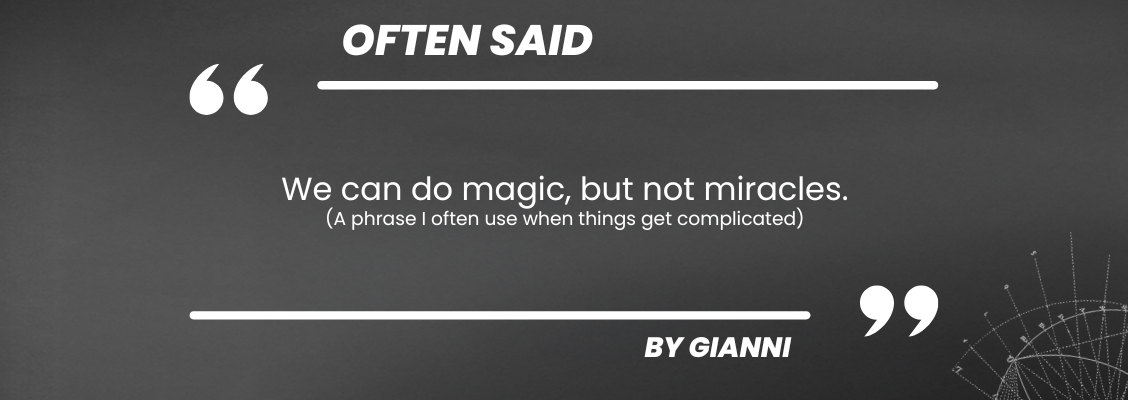
What made this project particularly challenging was its level of precision. We produced around 120 internal iterations and 80 client versions to achieve the final result. Watching the shot evolve felt like seeing a flipbook come to life. This experience reinforced my belief that quality doesn’t come from tools alone—it comes from communication, collaboration, and persistence.

I also had the opportunity to edit the making-of for the show, which allowed me to showcase the collective effort behind months of work.

Of course, working on Stranger Things 5 was equally exciting. Being part of such a cultural phenomenon—and seeing your name in the credits—is truly special. And I know this feeling is equally shared by everyone at The Yard.

Dive into the VFX of the France-based studio The Yard and explore what the artists delivered on the Upside Down universe in "Stranger Things 5"
Stranger Things 5 © 2025 Netflix - VFX by The Yard

Does working on a series versus a film change the way you approach VFX editing? What tends to shape your workflow on a project?

Today, the line between films and high-end series is almost nonexistent in terms of visual quality. Whether it’s a feature film or a major series like The Rings of Power, the level of expectation is equally high.

That said, the format has a direct impact on how we work—particularly in terms of volume and pace. On series, we’re dealing with a much larger number of shots and an ongoing flow of updates. Unlike feature films, where the edit tends to gradually settle, series production often feels like a constant influx of new versions and evolving cuts.

This means handling a daily stream of plates, editorial updates, and iterations. From the very first version to sometimes dozens of client delivery, every single update has to be tracked, checked, and perfectly integrated into the timeline. Everything needs to match with absolute precision to ensure the entire pipeline runs smoothly from start to finish.

Faced with such a diversity of sequences and constant changes, maintaining a strong overall vision is essential. My role is to instantly detect even the smallest inconsistency—whether it’s a continuity issue, a color shift, or a framing mismatch—while keeping the bigger picture in mind.

On productions of this scale, VFX editing truly becomes the studio’s control tower: a central point where all information converges, ensuring that every department stays aligned despite the complexity and pace of the workflow.
What major evolution do you see upcoming in VFX editing?

Artificial intelligence will undoubtedly play a major role in the future of VFX editing. It will automate many repetitive and technical tasks, making workflows less manual , less linear and more efficient.

From conforming processes to media relinking, optical effects handling, exports, and even generating cuts, AI has the potential to save time at every stage.

However, in post-production, we very often solve unexpected problems—something AI still struggles with. While AI can execute commands, it cannot yet improvise or creatively troubleshoot.

The VFX Editor’s eye remains essential. It’s not just about analyzing pixels—it’s about sensing whether something feels right. That intuitive, human judgment remains irreplaceable.

In short: AI executes, humans decide.

What advice would you give to students who would like to become VFX Editors?

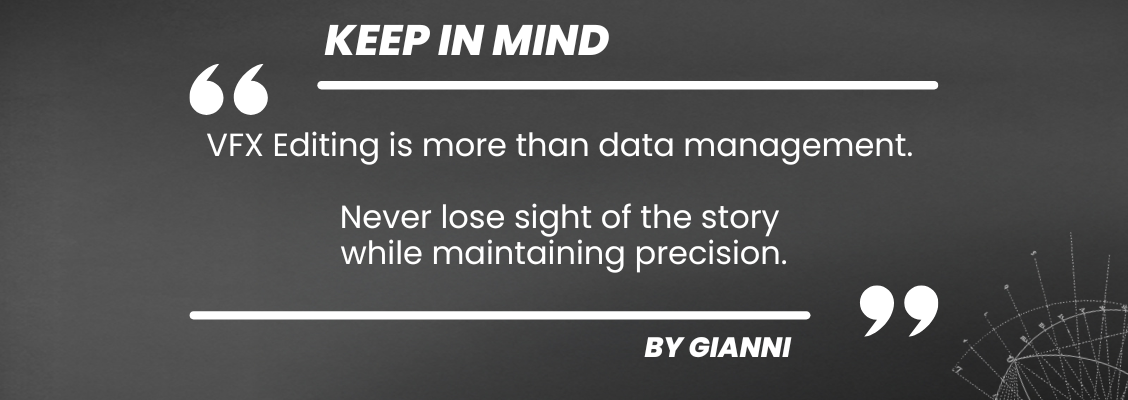
First, understand that this role goes beyond technical data management. While precision is essential, you must never lose sight of the film or the series itself, and continue developing your critical eye.

One of the risks is getting lost in spreadsheets. But working on a film or series means following a story over months. I encourage to embrace that opportunity.

This role is also a unique gateway into the entire VFX ecosystem, and get an in-depth understanding of the collaboration between all the services and artists working together on a show. As a VFX Editor, you’re at the center of all of it.

Don’t think of yourself as just an editor but as an image technician. Where traditional editing stops at selecting takes, VFX editing dives inside the image itself. You analyze every layer, from raw footage to final compositing, and discover the tiniest details. You end up developing almost an X-ray vision of every shot.

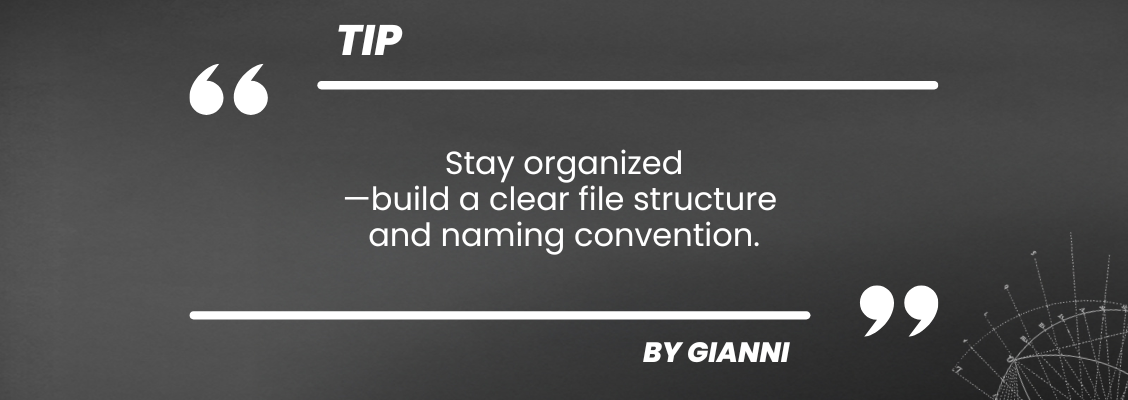
And finally, a very practical piece of advice: learn to stay organized. Your file structure and naming conventions should be so clear that another editor could take over your project instantly without needing explanations. That level of discipline is what allows you to handle multiple projects calmly and efficiently.

Press Enter / Return to begin your search or hit ESC to close.

New membership are not allowed.